
Willi Ninja
The Godfather of Vogue

He coached Tyra Banks and Naomi Campbell on their runway. He danced for Janet Jackson. He graced the catwalks of Chanel, Jean Paul Gaultier, Thierry Mugler, and Karl Lagerfeld. And he made vogue what it is today.
William Roscoe Leake, otherwise known as Willi Ninja, grew up in Flushing, Queens in the 1960s. Although not much is known about his childhood, he would tell stories of how his mother was lovingly accepting of his sexuality and nurturing of his interest in dance. He never actually came out to his mother; it was she who approached him, saying that “mothers always know,” and that she would love him no matter what.
A self-taught dancer, Willi formed a dance group after moving to Greenwich Village in the 1980s. Dubbed the Video Pretenders, they would stomp into local clubs and perform the choreography from music videos being played on the screens behind them. Willi soon began voguing at the Christopher Street Pier and Washington Square Park, popular hangouts for queer youth, and making his debut in Harlem’s famous ballroom scene.
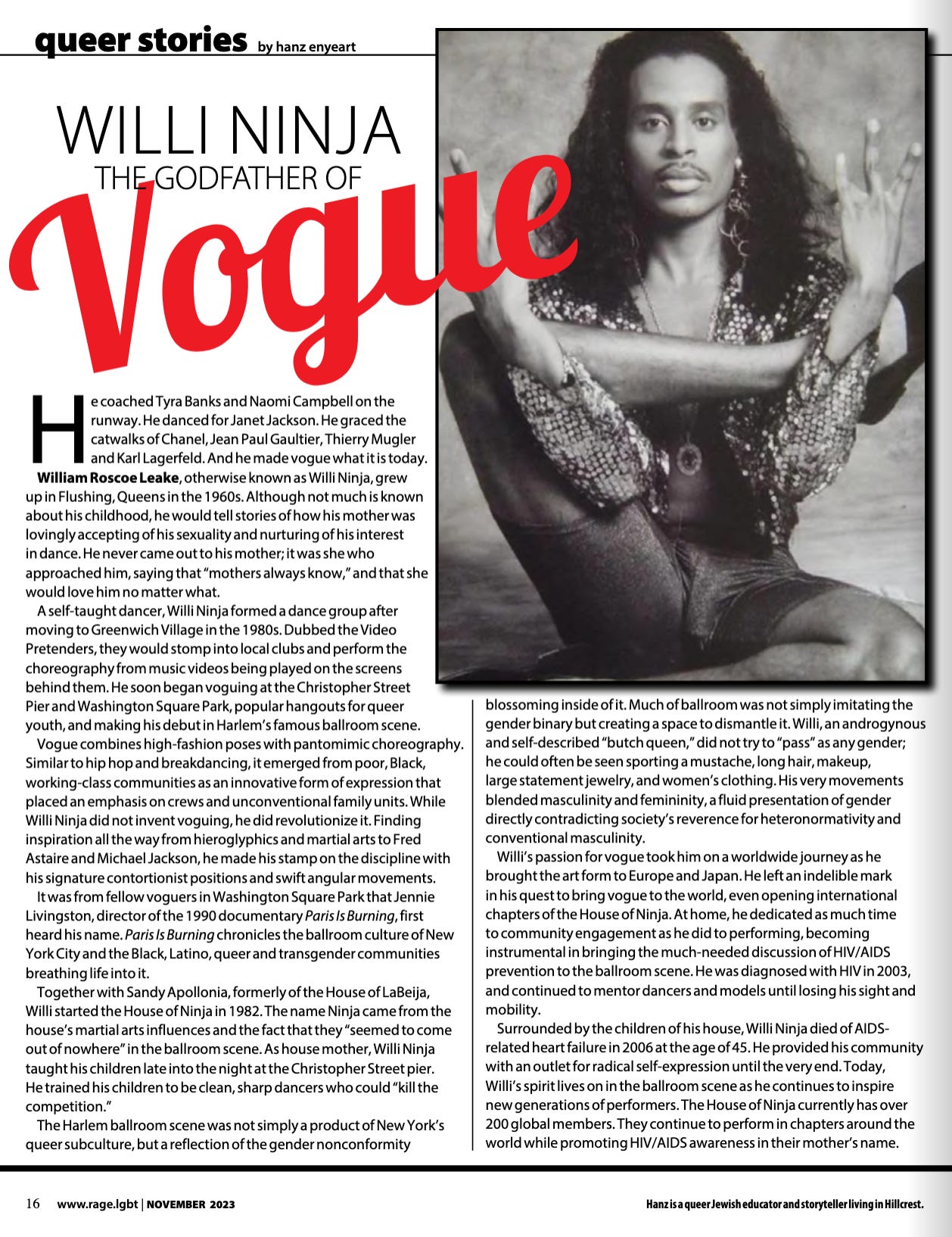
Vogue combines high-fashion poses with pantomimic choreography. Similar to hip hop and breakdancing, it emerged from poor, Black, working class communities as a innovative form of expression that placed an emphasis on crews and unconventional family units. While Willi did not invent voguing, he did revolutionize it. Finding inspiration all the way from hieroglyphics and martial arts to Michael Jackson and Fred Astaire, his stamp on the discipline was his signature contortionist positions and swift angular movements.
It was from fellow voguers in Washington Square Park that Jennie Livingston, director of the documentary Paris Is Burning, first heard his name. Paris is Burning (1990) chronicles the ballroom culture of New York City and the Black, Latino, queer, and transgender communities breathing life into it.
Together with Sandy Apollonia, formerly of the House of LaBeija, Willi started the House of Ninja in 1982. The name Ninja came from the house's martial arts influences and the fact that they “seemed to come out of nowhere” in the ballroom scene. As house mother, Willi taught his children late into the night at the Christopher Street pier. He trained his children to be clean, sharp dancers who could “kill the competition.”
The ballroom scene in Harlem was not simply a product of New York’s queer subculture, but a reflection of the gender nonconformity blossoming inside of it. Much of ballroom was not simply imitating the gender binary, but creating a space to dismantle it. Willi, an androgynous and self-described “butch queen,” did not try to “pass” as any gender; he could often be seen sporting a mustache, long hair, makeup, large statement jewelry, and women’s clothing. His very movements blended masculinity and femininity, a fluid presentation of gender directly contradicting society’s reverence for heteronormativity and conventional masculinity.
Willi’s passion for vogue took him on a worldwide journey as he brought the art form to places like Europe and Japan. He left an indelible mark in his quest to bring vogue to the world, even opening international chapters of the House of Ninja. At home, he dedicated as much time to community engagement as he did to performing, becoming instrumental in bringing the much-needed discussion of HIV/AIDS prevention to the ballroom scene. He was diagnosed with HIV in 2003 and continued to mentor dancers and models until losing his sight and mobility.
Surrounded by the children of his house, Willi Ninja died of AIDS-related heart failure in 2006 at the age of 45. He provided his community with an outlet for radical self-expression until the very end. Today, Willi’s spirit lives on in the ballroom scene as he continues to inspire new generations of performers. The House of Ninja currently has over 200 global members. They continue to perform in chapters around the world while promoting HIV/AIDS awareness in their mother’s name.