
Two Spirits, Returning
Two Spirit identity in a modern world

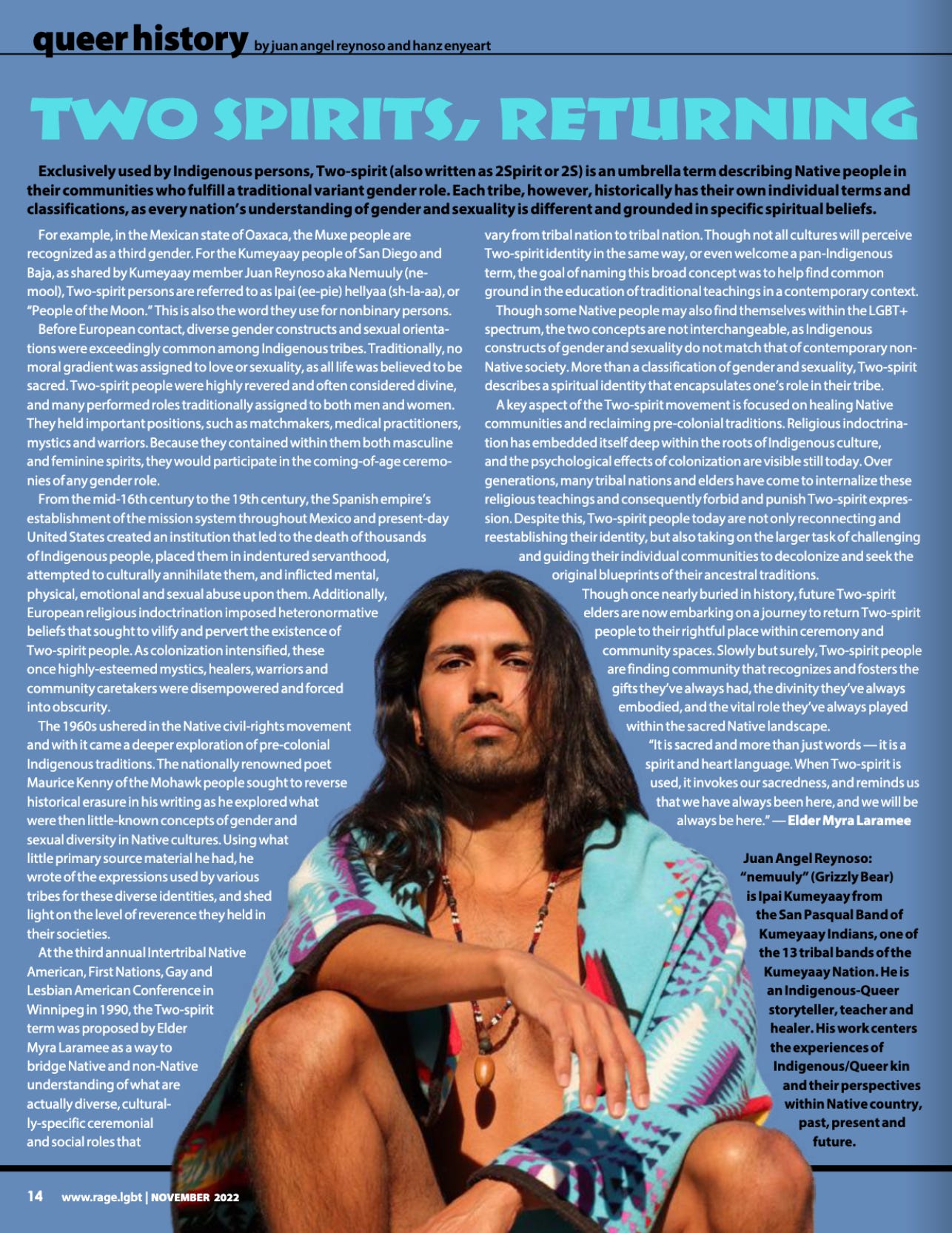
Cowritten by Juan Angel Reynoso
Exclusively used by Indigenous persons, Two-spirit (also written as 2Spirit or 2S) is an umbrella term describing Native people in their communities who fulfill a traditional variant gender role. Each tribe, however, historically has their own individual terms and classifications, as every nation’s understanding of gender and sexuality is different and grounded in specific spiritual beliefs. For example, in the Mexican state of Oaxaca, the Muxe people are recognized as a third gender. For the Kumeyaay people of San Diego and Baja, as shared by Kumeyaay member Juan Reynoso aka Nemuuly (ne-mool), Two-spirit persons are referred to as Ipai (ee-pie) hellyaa (sh-la-aa), or “People of the Moon.” This is also the word they use for nonbinary persons.
Prior to European contact, diverse gender constructs and sexual orientations were exceedingly common among Indigenous tribes. Traditionally, no moral gradient was assigned to love or sexuality, as all life was believed to be sacred. Two-spirit people were highly revered and often considered divine, and many performed roles traditionally assigned to both men and women. They held important positions, such as matchmakers, medical practitioners, mystics, and warriors. Because they contained within them both masculine and feminine spirits, they would participate in the coming-of-age ceremonies of any gender role.
From the mid-16th to 19th century, the Spanish empire’s establishment of the mission system throughout Mexico and present-day United States created an institution that led to the death of thousands of Indigenous people, placed them in indentured servanthood, attempted to culturally annihilate them, and inflicted mental, physical, emotional, and sexual abuse upon them. Additionally, European religious indoctrination imposed heteronormative beliefs that sought to vilify and pervert the existence of Two-spirit people. As colonization intensified, these once highly-esteemed mystics, healers, warriors, and community caretakers were disempowered and forced into obscurity.
The 1960s ushered in the Native civil rights movement, and with it, a deeper exploration of pre-colonial Indigenous traditions. The nationally-renowned poet Maurice Kenny of the Mohawk people sought to reverse historical erasure in his writing as he explored what were then little-known concepts of gender and sexual diversity in Native cultures. Using what little primary source material he had, he wrote of the expressions used by various tribes for these diverse identities, and shed light on the level of reverence they held in their societies.
At the Third Annual Intertribal Native American, First Nations, Gay and Lesbian American Conference in Winnipeg (1990), the Two-spirit term was proposed by Elder Myra Laramee as a way to bridge Native and non-Native understanding of what are actually diverse, culturally-specific ceremonial and social roles that vary from tribal nation to tribal nation. Though not all cultures will perceive Two-spirit identity in the same way, or even welcome a pan-Indigenous term, the goal of naming this broad concept was to help find common ground in the education of traditional teachings in a contemporary context.
Though some Native people may also find themselves within the LGBT+ spectrum, the two concepts are not interchangeable, as Indigenous constructs of gender and sexuality do not match that of contemporary non-Native society. More than a classification of gender and sexuality, Two-spirit describes a spiritual identity that encapsulates one’s role in their tribe.
A key aspect of the Two-spirit movement is focused on healing Native communities and reclaiming pre-colonial traditions. Religious indoctrination has embedded itself deep within the roots of Indigenous culture, and the psychological effects of colonization are visible still today. Over generations, many tribal nations and elders have come to internalize these religious teachings and consequently forbid and punish Two-spirit expression. Despite this, Two-spirit people today are not only reconnecting and reestablishing their identity, but also taking on the larger task of challenging and guiding their individual communities to decolonize and seek the original blueprints of their ancestral traditions.
Though once nearly buried in history, future Two-spirit elders are now embarking on a journey to return Two-spirit people to their rightful place within ceremony and community spaces. Slowly but surely, Two-spirit people are finding community that recognizes and fosters the gifts they’ve always had, the divinity they’ve always embodied, and the vital role they’ve always played within the sacred Native landscape.
“It is sacred and more than just words – it is a spirit and heart language. When Two-spirit is used, it invokes our sacredness, and reminds us that we have always been here, and we will be always be here.” -Elder Myra Laramee
[Juan Angel Reynoso; “nemuuly” (Grizzly Bear) is Ipai Kumeyaay from the San Pasqual Band of Kumeyaay Indians, one of the 13 tribal bands of the Kumeyaay Nation. An Indigenous-Queer Storyteller, Teacher, and Healer, his work centers the experiences of Indigenous/Queer Kin and their perspectives within Native country; past, present, and future.]