
Through Science, Queer Liberation
Magnus Hirschfeld, the scientist before his time

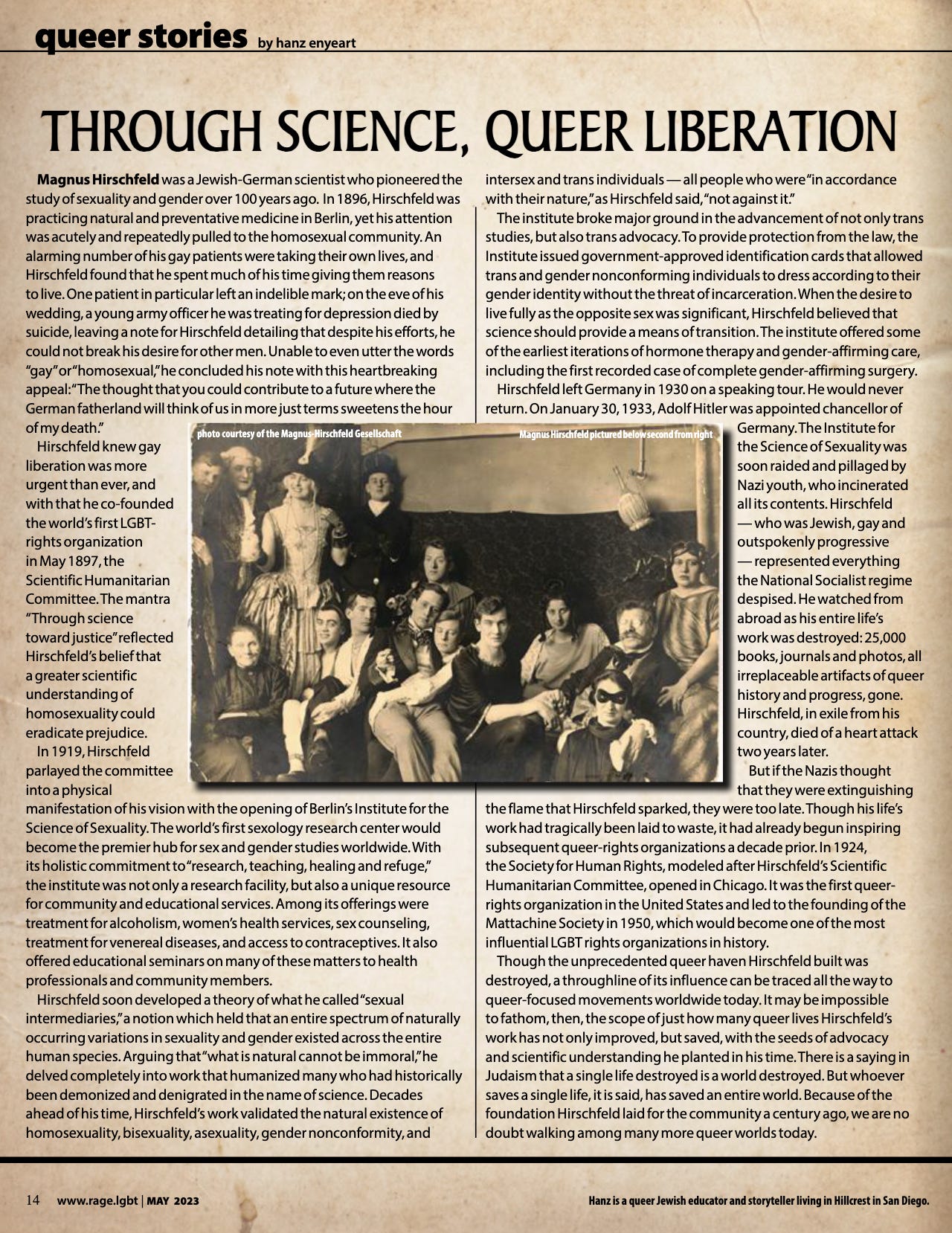
Magnus Hirschfeld was a Jewish-German scientist who pioneered the study of sexuality and gender over a hundred years ago.
In 1896, Hirschfeld was practicing natural and preventative medicine in Berlin, yet his attention was acutely and repeatedly pulled to the homosexual community. An alarming number of his gay patients were taking their own lives, and Hirschfeld found he spent much of his time giving them reasons to live. One patient in particular left an indelible mark; on the eve of his wedding, a young army officer he was treating for depression died by suicide, leaving a note for Hirschfeld detailing that despite his efforts, he could not break his desire for other men. Unable to even utter the words “gay” or "homosexual,” he concluded his note with this heartbreaking appeal: "The thought that you could contribute to a future where the German fatherland will think of us in more just terms sweetens the hour of my death."
Hirschfeld knew gay liberation was more urgent than ever, and with that he co-founded the world’s first gay rights organization in 1897, the Scientific Humanitarian Committee. The
mantra "Through science toward justice” reflected Hirschfeld's belief that a greater scientific understanding of homosexuality could eradicate prejudice.
In 1919, Hirschfeld parlayed the Committee into a physical manifestation of his vision with the opening of Berlin’s Institute for the Science of Sexuality. The world’s first sexology research center, it would become the premiere hub for sex and gender studies worldwide. With its holistic commitment to “research, teaching, healing, and refuge,” the Institute was not only a research facility, but also a unique resource for community and educational services. Among its offerings were treatment for alcoholism, women’s health services, sex counseling, treatment for venereal diseases, and access to contraceptives. It also offered educational seminars on many of these matters to both health professionals and community members.
Hirschfeld soon developed a theory of what he called “sexual intermediaries,” a notion which held that an entire spectrum of naturally occurring variations in sexuality and gender existed across the entire human species. Arguing that “what is natural cannot be immoral,” he delved completely into work that humanized many who had historically been demonized and denigrated in the name of science. Decades ahead of his time, his work validated the natural existence of homosexuality, bisexuality, asexuality, gender nonconformity, and intersex and trans individuals – all people who were “in accordance with their nature,” as Hirschfeld said, “not against it.”
The Institute broke major ground in the advancement of not only trans studies, but also trans advocacy. To provide protection from the law, the Institute issued government-approved identification cards that allowed trans and gender nonconforming individuals to dress according to their gender identity without the threat of incarceration. When the desire to live fully as the opposite sex was significant, Hirschfeld believed science should provide a means of transition. The Institute offered some of the earliest iterations of hormone therapy and gender-affirming care, including the first ever recorded case of complete gender-affirming surgery.
Hirschfeld left Germany in 1930 for a speaking tour. He would never return. On January 30, 1933, Adolf Hitler was appointed chancellor of Germany. The Institute for the Science of Sexuality was soon raided and pillaged by Nazi youth, who incinerated all its contents. Hirschfeld – who was Jewish, gay, and outspokenly progressive - represented everything the National Socialist regime despised. He watched from abroad as his entire life’s work was destroyed; 25,000 books, journals, and photos, all irreplaceable artifacts of queer history and progress, gone. Hirschfeld, in exile from his country, died of a heart attack two years later.
But if the Nazis thought they were extinguishing the flame that Hirschfeld sparked, they were too late. Though his life’s work had tragically been laid to waste, it had already begun inspiring subsequent queer rights organizations a decade prior. In 1924, the Society for Human Rights, modeled after Hirschfeld’s Scientific Humanitarian Committee, opened in Chicago. It was the very first queer rights organization in the U.S., and led to the founding of the Mattachine Society in 1950, which would become one of the most influential LGBT rights organizations in history.
Though the unprecedented queer haven Hirschfeld built was destroyed, a throughline of its influence can be traced all the way to queer-focused movements worldwide today. It may be impossible to fathom, then, the scope of just how many queer lives Hirschfeld’s work has not only improved, but saved, with the seeds of advocacy and scientific understanding he planted in his time. There is a saying in Judaism that a single life destroyed is a world destroyed. But whoever saves a single life, it is said, has saved an entire world. Because of the foundation Hirschfeld laid for the community a century ago, we are no doubt walking among many more queer worlds today.