
The Pink Triangle
The Fate of Homosexuals in Nazi Germany

January 27 is International Holocaust Remembrance Day.
Queer life in Germany was thriving in the early 20th century. A vibrant social scene had flourished in Berlin alongside new academic philosophies challenging sexual and gender norms. Magnus Hirschfeld’s Institute for Sexual Science was a global innovator in its scientific approach to human sexuality. Hirschfeld, a gay Jewish man, created gay and lesbian “friendship leagues,” which sought to educate the public and affirm homosexuality as inborn. Though Paragraph 175 of the German Penal Code criminalized homosexual acts, its enforcement was waning. And by the late 1920s, the German legislature was on its way to scrapping it completely.
After a failed coup attempt ten years prior, Adolf Hitler was appointed Chancellor of Germany in January 1933. The purge of homosexual society began within weeks. Within the National Socialist vision, gay men were weak and unlikely to contribute to the growth of the “master race.” Meanwhile, Ernst Röhm, a high-ranking Nazi official, was a known homosexual. However, he subscribed to an ultra-macho image of masculinity, distancing himself from “soft” homosexuals. He was also a close friend of Hitler, which aided in his survival through the anti-gay purge.
A climate of fear quickly overcame the homosexual community. Some fled the country, some married opposite-sex partners. Others were sent to the concentration camps that began springing up in March 1933 under the “Extermination Through Work” campaign.
In May 1933, Nazi Youth infiltrated Magnus Hirschfeld’s Institute for Sexual Science and publicly burned its library. The only documents to survive were extensive name and address lists, which the Nazis kept. By 1934, these "pink lists" were widely being utilized to hunt down individual homosexuals. Those arrested were used to generate lists of other homosexuals, eventually exposing the entire community.
The tides ultimately turned for Ernst Röhm. In preparation for the Night of the Long Knives, where Hitler would purge those he deemed internal threats, two high-ranking officials forged evidence suggesting Röhm had been paid by the government of France to overthrow the Nazi leader. Röhm was subsequently executed.
During the 1935 redrafting of Paragraph 175, there was much debate about whether to include lesbianism in the criminalization of homosexuality. Though lesbian social clubs and publications had been shut down, homosexual acts between two women were not illegal. Ultimately, lesbianism was not included in the redraft of Paragraph 175. The reasoning drew upon Nazi attitudes about the differences between male and female sexuality, believing Aryan lesbians could be easily persuaded or forced to bear children. Ministry officials did, however, expand criminalized homosexuality to include any act that could even be construed as homosexual. They also decided that the intention or contemplation of a homosexual act was sufficient enough for arrest. During this time, police had the power to jail anyone indefinitely without trial.
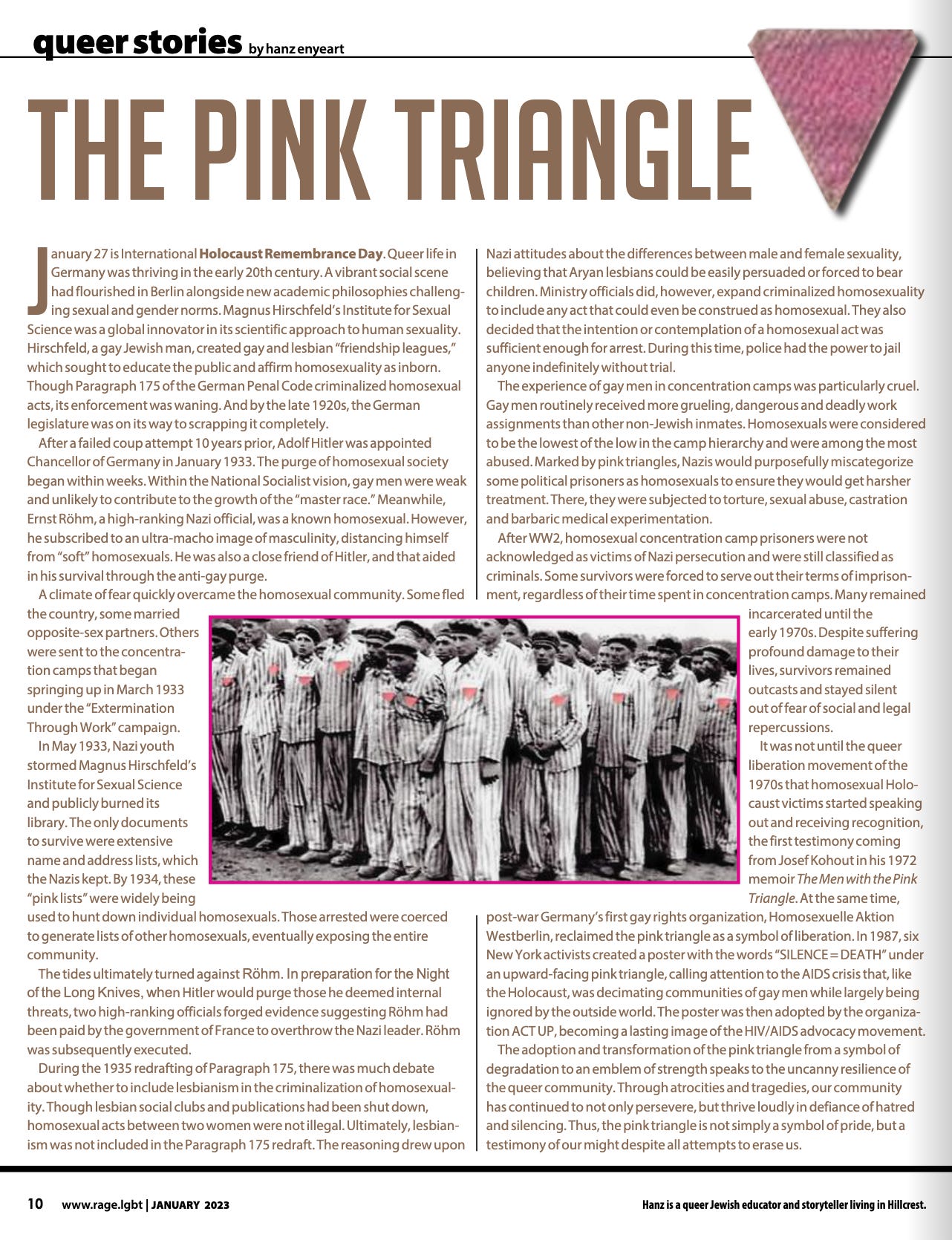
The experience of gay men in concentration camps was particularly cruel. Gay men routinely received more grueling, dangerous, and deadly work assignments than other non-Jewish inmates. Homosexuals were considered to be the lowest of the low in the camp hierarchy and were among the most abused. Marked by pink triangles, Nazi officials would purposefully miscategorize some political prisoners as homosexuals in order to ensure they’d receive harsher treatment. There, they were subjected to torture, sexual abuse, castration, and barbaric medical experimentation.
After WW2, homosexual concentration camp prisoners were not acknowledged as victims of Nazi persecution, and were still classified as criminals. Some survivors were forced to serve out their terms of imprisonment, regardless of their time spent in concentration camps. Many remained incarcerated until the early 1970s. Despite suffering profound damage to their lives, survivors remained outcasts and stayed silent out of fear of social and legal repercussions.
It was not until the queer liberation movement of the 1970s that homosexual Holocaust victims started speaking out and receiving recognition, the first testimony coming from Josef Kohout in his 1972 memoir The Men With the Pink Triangle. At the same time, post-war Germany’s first gay rights organization, Homosexuelle Aktion Westberlin reclaimed the pink triangle as a symbol of liberation. In 1987, six New York activists created a poster with the words “SILENCE = DEATH” under an upward-facing pink triangle, calling attention to the AIDS crisis that, like the Holocaust, was decimating communities of gay men while largely being ignored by the outside world. The poster was then adopted by the organization ACT UP, becoming a lasting image of the HIV/AIDS advocacy movement.
The adoption and transformation of the pink triangle from a symbol of degradation to an emblem of strength speaks to the uncanny resilience of the queer community. Through atrocities and tragedies, our community has continued to not only persevere, but thrive loudly in defiance of hatred and silencing. Thus, the pink triangle is not simply a symbol of pride, but a testimony of our might despite all attempts to erase us.