
The Lavender Scare
The little-known moral panic of the 1950s

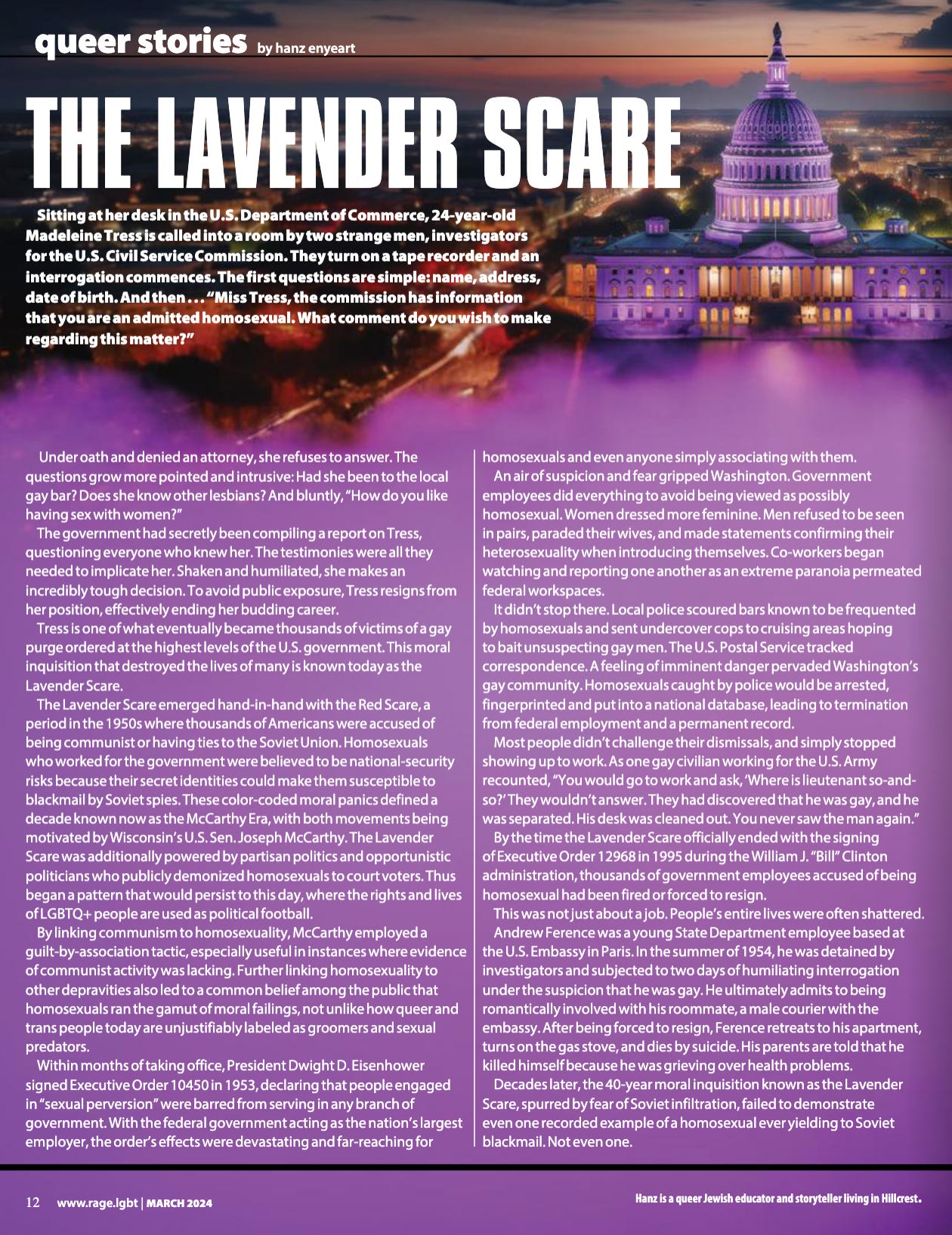
Sitting at her desk in the U.S. Department of Commerce, 24-year old Madeleine Tress is called into a room by two strange men - investigators for the U.S. Civil Service Commission. They turn on a tape recorder and an interrogation commences. The first questions are simple: name, address, date of birth. And then… “Miss Tress, the commission has information that you are an admitted homosexual. What comment do you wish to make regarding this matter?” Under oath and denied an attorney, she refuses to answer. The questions grow more pointed and intrusive; had she been to the local gay bar? Does she know other lesbians? And bluntly – “How do you like having sex with women?”
The government had secretly been compiling a report on Madeleine, questioning everyone who knew her. The testimonies were all they needed to implicate her. Shaken and humiliated, she makes an incredibly tough decision. In order to avoid public exposure, Madeleine resigns from her position, effectively ending her budding career.
Madeleine is one of what eventually became thousands of victims of a gay purge ordered at the highest levels of the U.S. government. A moral inquisition that destroyed the lives of many, it is known today as the Lavender Scare.
The Lavender Scare emerged hand-in-hand with the Red Scare - a period in the 1950s where thousands of Americans were accused of being communist or having ties to the Soviet Union. Homosexuals who worked for the government were believed to be national security risks because their secret identities made them susceptible to blackmail by Soviet spies. These color-coded moral panics defined a decade known now as the McCarthy Era, with both movements being motivated by Wisconsin senator Joseph McCarthy. The Lavender Scare, however, was additionally powered by domestic partisan politics and politicians who publicly demonized homosexuals in order to court voters. Beginning a pattern that would persist to this day, the rights and lives of LGBTQ+ people were used as political football.
By linking communism to homosexuality, McCarthy employed a guilt-by-association tactic, especially useful in instances where evidence of communist activity was lacking. Further linking homosexuality to other depravities also led to a common belief among the public that homosexuals ran the gamut of moral failings, not unlike how queer and trans people today are unjustifiably labeled as groomers and sexual predators.
Within months of taking office, President Eisenhower signed Executive Order 10450 in 1953, declaring that people engaged in “sexual perversion” were barred from serving in any branch of government. With the federal government acting as the nation’s largest employer, the effects of this order were devastating and far-reaching for homosexuals and even anyone simply associating with them.
An air of suspicion and fear gripped Washington. Government employees did everything to avoid being viewed as possibly homosexual. Women dressed more feminine. Men refused to be seen in pairs, paraded their wives, and made statements confirming their heterosexuality when introducing themselves. Co-workers began watching and reporting one another as an extreme paranoia permeated federal workspaces.
It didn’t stop there. Local police scoured bars known to be frequented by homosexuals and sent undercover cops to cruising areas hoping to bait unsuspecting gay men. The Postal Service tracked correspondence. A feeling of imminent danger pervaded Washington’s gay community. Homosexuals caught by police would be arrested, fingerprinted, and put into a national database, leading to termination from federal employment and a permanent record.
Most people didn't challenge their dismissals - they simply stopped showing up to work. As one gay civilian working for the army recounted, "You would go to work and ask, 'Where is lieutenant so-and-so?' They wouldn't answer. They had discovered that he was gay, and he was separated. His desk was cleaned out. You never saw the man again."
By the time the Lavender Scare officially ended with the signing of Executive Order 12968 in 1995, thousands of government employees accused of being homosexual had been fired or forced to resign.
This was not just about a job - people's entire lives were often shattered. Andrew Ference was a young State Department employee based at the U.S. Embassy in Paris. In the summer of 1954, Andrew was detained by investigators and subjected to two days of humiliating interrogation under the suspicion that he was gay. He ultimately admits to being romantically involved with his roommate, a male courier with the embassy. After being forced to resign, Andrew retreats to his apartment, turns on the gas stove, and dies by suicide. His parents are told that he killed himself because he was grieving over health problems.
Decades later, the 40-year moral inquisition known as the Lavender Scare, spurred by fear of Soviet infiltration, failed to demonstrate even one recorded example of a homosexual ever yielding to Soviet blackmail. Not even one.