
The Helpers
The Heroic Blood Sisters of San Diego

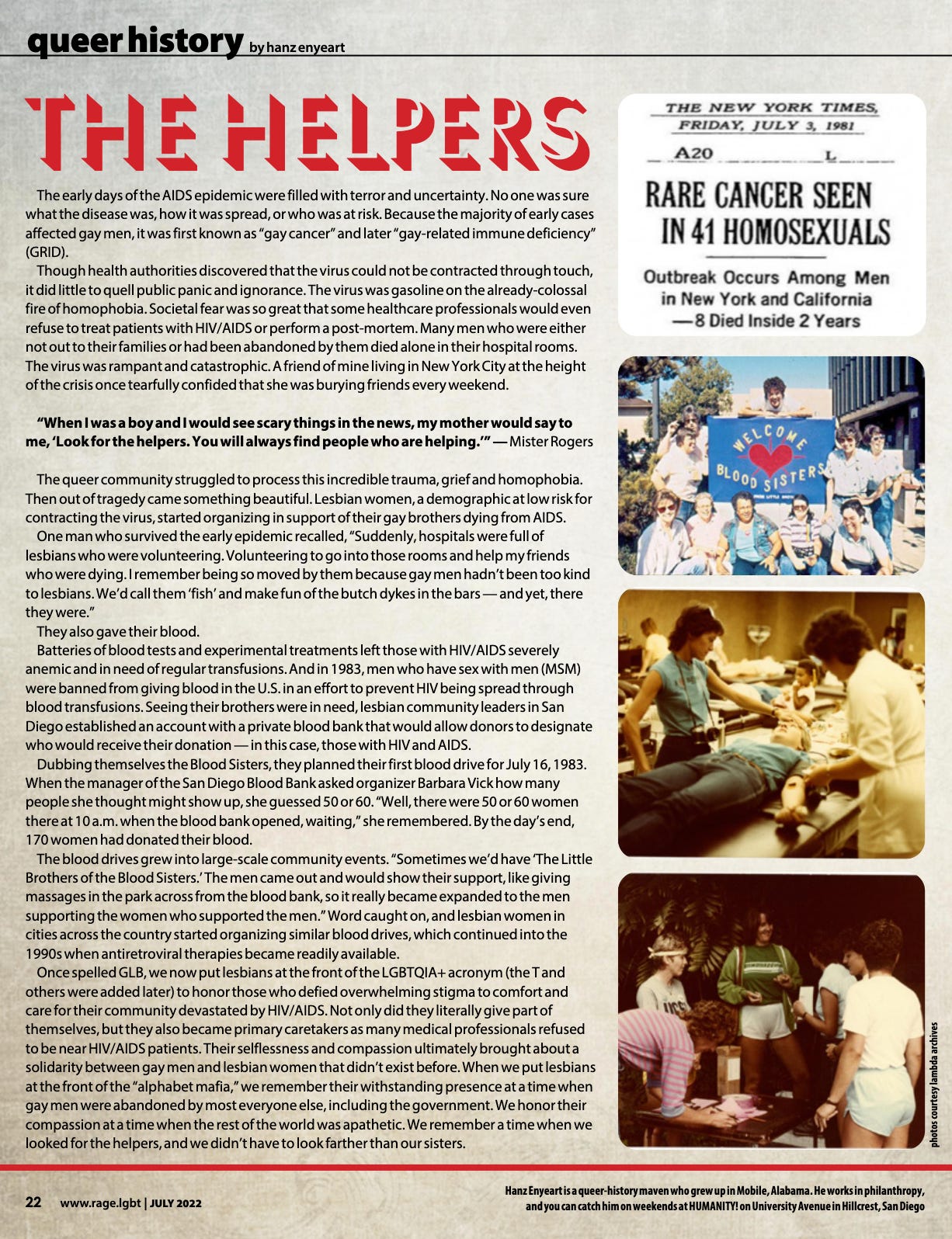
“RARE CANCER SEEN IN 41 HOMOSEXUALS” - The New York Times (July 3, 1981)
The early days of the AIDS epidemic were filled with terror and uncertainty. No one was sure what the disease was, how it was spread, or who was at risk. Because the majority of early cases affected gay men, it was first known as “gay cancer” and later “gay-related immune deficiency” (GRID).
Though health authorities discovered that the virus could not be contracted through touch, it did little to quell public panic and ignorance. The virus was gasoline on the already-colossal fire of homophobia. Societal fear was so great that some healthcare professionals would even refuse to treat or perform a post-mortem on patients with HIV/AIDS. Many men who were either not out to their families or had been abandoned by them died alone in their hospital rooms. The virus was rampant and catastrophic. A friend of mine living in NYC at the height of the crisis once tearfully confided in me that she was burying friends every weekend.
“When I was a boy and I would see scary things in the news, my mother would say to me, ‘Look for the helpers. You will always find people who are helping.’”
- Mister Rogers
The queer community struggled to process this incredible trauma, grief, and homophobia. Then out of tragedy came something beautiful. Lesbian women, a demographic at low risk for contracting the virus, started organizing in support of their gay brothers dying from AIDS.
One man who survived the early epidemic recalled, “Suddenly, hospitals were full of lesbians who were volunteering. Volunteering to go into those rooms and help my friends who were dying. I remember being so moved by them because gay men hadn’t been too kind to lesbians. We’d call them ‘fish’ and make fun of the butch dykes in the bars – and yet, there they were.”
They also gave their blood.
Batteries of blood tests and experimental treatments left those with HIV/AIDS severely anemic and in need of regular transfusions. And in 1983, MSM (men who have sex with men) were banned from giving blood in the US in an effort to prevent HIV being spread through blood transfusions. Seeing their brothers were in need, lesbian community leaders in San Diego, CA established an account with a private local blood bank which would allow donors to designate who would receive their donation – in this case, those with HIV and AIDS.
Dubbing themselves The Lesbian Blood Sisters, they planned their first blood drive for July 16, 1983. When the manager of the San Diego Blood Bank asked organizer Barbara Vick how many people she thought might show up, she guessed 50 or 60. “Well, there were 50 or 60 women there at 10:00am when the blood bank opened, waiting,” she remembers. By the day’s end, 170 women had donated their blood.
The blood drives grew into large-scale community events. “Sometimes we’d have ‘The Little Brothers of the Blood Sisters’. The men came out and would show their support, like giving massages in the park across from the blood bank, so it really became expanded to the men supporting the women who supported the men.” Word caught on, and lesbian women in cities across the country started organizing similar blood drives, which continued into the 1990s when antiretroviral therapies became readily available.
Once spelled GLB, we now put lesbians at the front of the LGBTQIA+ acronym (the T and others were added later) to honor those who defied overwhelming stigma in order to comfort and care for their community devastated by HIV/AIDS. Not only did they literally give part of themselves, but they also became primary caretakers as many medical professionals refused to be near HIV/AIDS patients. Their selflessness and compassion ultimately brought about a solidarity between gay men and lesbian women that didn’t exist before. When we put lesbians at the front of the “alphabet mafia,” we remember their withstanding presence at a time when gay men were abandoned by most everyone else, including the government. We honor their compassion at a time when the rest of the world was apathetic. We remember a time when we looked for the helpers, and we didn’t have to look farther than our sisters.