
Queer'd Science
The Enigmatic & Pioneering Octavia E. Butler

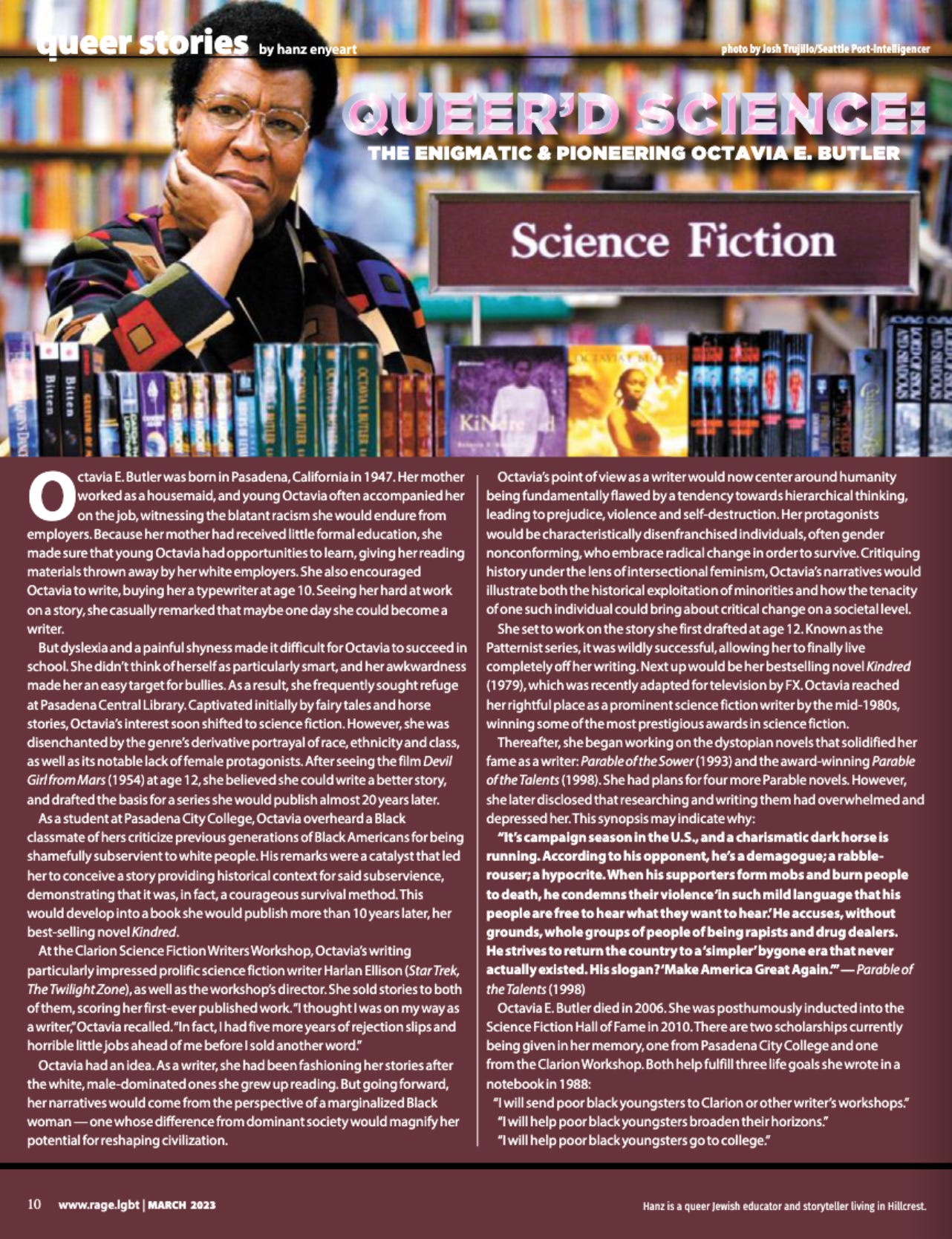
Octavia Butler was born in Pasadena, California in 1947. Her mother worked as a housemaid, and young Octavia often accompanied her on the job, witnessing the blatant racism she would endure from employers. Because her mother had received little formal education, she made sure young Octavia had opportunities to learn, giving her reading materials thrown away by her white employers. She also encouraged Octavia to write, buying her a typewriter at age 10. Seeing her hard at work on a story, she casually remarked that maybe one day she could become a writer.
But dyslexia and a painful shyness made it difficult for Octavia to succeed in school. She didn’t think of herself as particularly smart, and her awkwardness made her an easy target for bullies. As a result, she frequently sought refuge at the Pasadena Central Library. Captivated initially by fairy tales and horse stories, her interest soon shifted to science fiction. However, she was disenchanted by the genre's derivative portrayal of race, ethnicity, and class, as well as its notable lack of female protagonists. After seeing the film Devil Girl from Mars (1954) at age 12, she believed she could write a better story, and drafted the basis for a series she would publish almost 20 years later.
As a student at Pasadena City College, Octavia overheard a Black classmate of hers criticize previous generations of Black Americans for being shamefully subservient to white people. His remarks were a catalyst that led her to conceive a story providing historical context for said subservience, demonstrating that it was, in fact, a courageous survival method. This would develop into a book she’d publish more than 10 years later, her best-selling novel Kindred.
At the Clarion Science Fiction Writers Workshop, Octavia’s writing particularly impressed prolific science fiction writer Harlan Ellison (Star Trek, The Twilight Zone), as well as the workshop’s director. She sold stories to both of them, scoring her first ever published work. "I thought I was on my way as a writer," Octavia recalled. “In fact, I had five more years of rejection slips and horrible little jobs ahead of me before I sold another word."
Octavia had an idea. As a writer, she had been fashioning her stories after the white, male-dominated ones she grew up reading. But going forward, her narratives would come from the perspective of a marginalized Black woman – one whose difference from dominant society would magnify her potential for reshaping civilization.
Octavia’s point of view as a writer would now center around humanity being fundamentally flawed by a tendency towards hierarchical thinking, leading to prejudice, violence, and self-destruction. Her protagonists would be characteristically disenfranchised individuals, often gender nonconforming, who embrace radical change in order to survive. Critiquing history under the lens of intersectional feminism, her narratives would illustrate both the historical exploitation of minorities and how the tenacity of one such individual could bring about critical change on a societal level.
She set to work on the story she first drafted at age 12. Known as the Patternist series, it was wildly successful, allowing her to finally live completely off her writing. Next up would be her best-selling novel Kindred (1979), which was recently adapted for television by FX. Octavia reached her rightful place as a prominent science fiction writer by the mid-1980s, winning some of the most prestigious awards in the science fiction industry.
Thereafter, she began working on the dystopian novels that solidified her fame as a writer: Parable of the Sower (1993) and the award-winning Parable of the Talents (1998). She had plans for four more Parable novels. However, she later disclosed that researching and writing them had overwhelmed and depressed her. This synopsis may indicate why:
“It’s campaign season in the U.S., and a charismatic dark horse is running. According to his opponent, he’s a demagogue; a rabble-rouser; a hypocrite. When his supporters form mobs and burn people to death, he condemns their violence ‘in such mild language that his people are free to hear what they want to hear.’ He accuses, without grounds, whole groups of people of being rapists and drug dealers. He strives to return the country to a ‘simpler’ bygone era that never actually existed. His slogan? ‘Make America Great Again.’”
- Parable of the Talents (1998)
Octavia Butler passed away in 2006. She was posthumously inducted into the Science Fiction Hall of Fame in 2010. There are two scholarships currently being given in her memory, one from Pasadena City College and one from the Clarion Workshop. Both help fulfill three life goals she wrote in a notebook in 1988:
"I will send poor black youngsters to Clarion or other writer's workshops.”
"I will help poor black youngsters broaden their horizons.”
"I will help poor black youngsters go to college."